


How to Develop a NFT Smart Contract
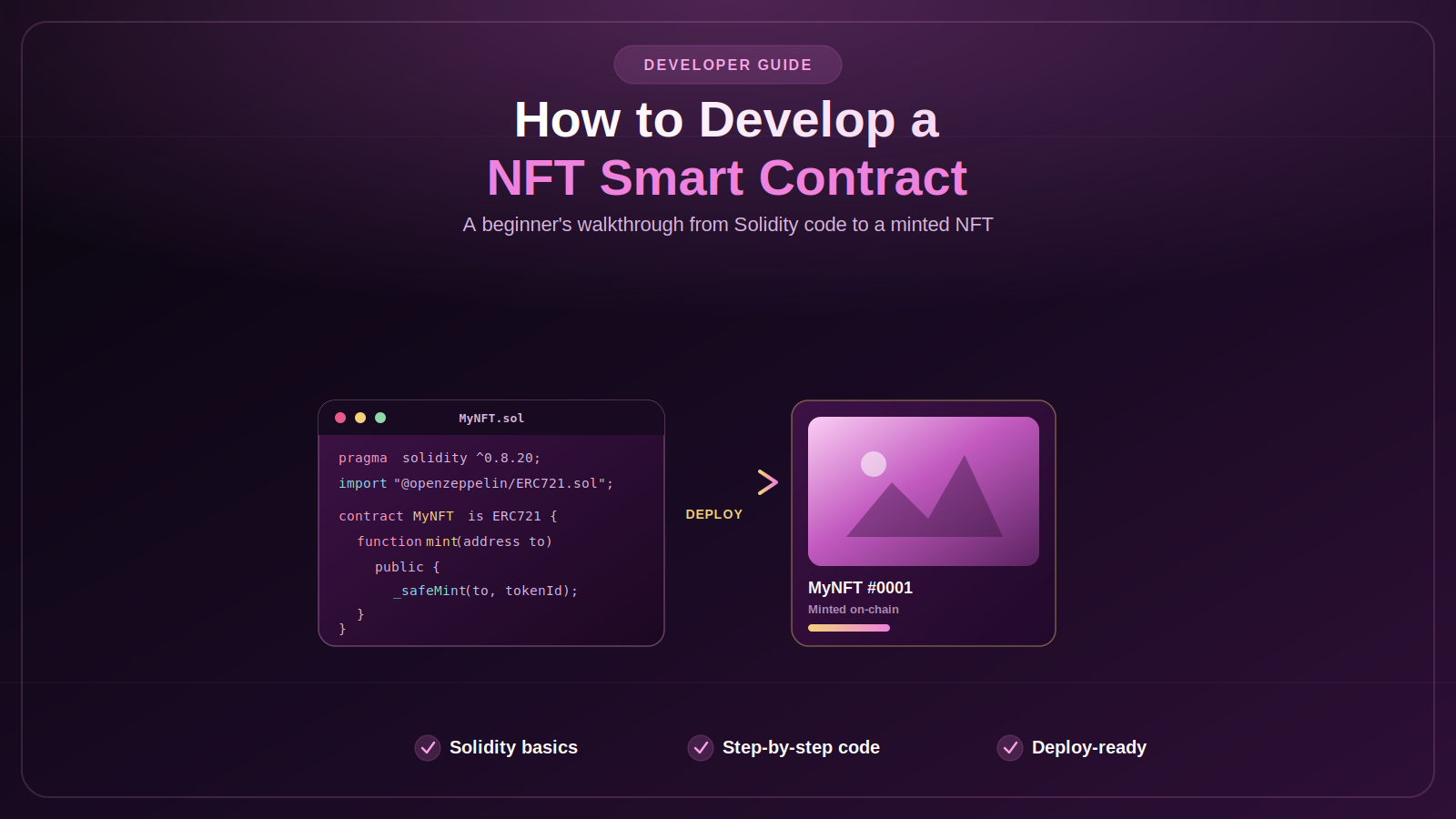
Construction of a NFT Smart Contract goes beyond just creating a digital asset. It entails knowledge of blockchain, selection of appropriate token standards, coding the smart contract, testing it, and then deployment on a blockchain platform. A good NFT smart contract governs the creation, transfer, ownership, and even sale or licensing of the NFT.
Choose Blockchain
Firstly, you have to pick a suitable blockchain network for developing your NFTs. There are many blockchain networks available to choose from; however, Ethereum stands out as an experienced one due to its wide adoption of the various popular standards and having many developers. Other blockchain networks to consider include Polygon, BNB Chain, and Avalanche.
The selection of a blockchain network affects the coding language used in building the smart contract.
Select Standard
NFTs commonly make use of existing token standards rather than developing their own system of ownership. The typical token standard on Ethereum-based platforms for NFTs is ERC-721. Another common standard is ERC-1155, which allows for both unique and semi-fungible assets in a single smart contract.
Selecting the right standard will make it easier for you to integrate with wallets, exchanges, dapps, and blockchain developer frameworks.
Install Tools
After choosing the appropriate blockchain and protocol, develop an appropriate development environment. The language that is extensively used for writing smart contracts for the Ethereum blockchain is Solidity.
A developer can utilize tools like the Remix IDE for web-based development and Hardhat/Foundry for more complex projects. A crypto wallet, like MetaMask, may also be used to interact with blockchains and deploy contracts.
Define Features
Before even beginning to write the code, it is imperative that one defines what the functionality of the NFT contract will be. Simple contracts might just need basic functions such as minting, ownership, and transfer. For more complex projects, some additional functionality may be required.
This helps ensure there is no unnecessary complexity.
Write Contract
The next stage is writing the Solidity smart contract. Instead of developing every function independently, developers commonly use established libraries such as OpenZeppelin. These libraries provide tested implementations for widely used NFT standards and security features.
A typical NFT contract contains functions for minting tokens, checking ownership, transferring NFTs, and connecting each token with its metadata.
Create Metadata
An NFT smart contract generally does not store the complete image, video, or other digital asset directly on the blockchain. Instead, each token usually points toward metadata describing the NFT.
Metadata can include the NFT’s name, description, image, attributes, and other information. Decentralized storage solutions such as IPFS are commonly used to reduce dependence on a single centralized server.
Add Minting
Minting is the process of creating an NFT and assigning it a unique token ID. The smart contract controls who can mint, how many NFTs can be created, and under what conditions.
Developers may create public minting, allowlist minting, owner-controlled minting, or other mechanisms. Supply limits should be implemented carefully if the collection has a fixed maximum quantity.
Implement Royalties
Some NFT projects include creator royalties that can provide creators with a percentage from qualifying secondary sales. However, royalties are not automatically enforced across every marketplace simply because they are included in a smart contract.
Standards such as ERC-2981 can communicate royalty information to supporting marketplaces. Developers should therefore understand both the technical standard and the marketplace ecosystem before relying on royalties as a revenue source.
Add Security
Security plays an important role in developing smart contracts. Transactions on the blockchain cannot be reversed, thus any vulnerabilities can cost a lot once deployed.
Libraries should be used, sensitive functions restricted, inputs validated, and best security practices followed. Some typical problems that developers can face when writing smart contracts are unauthorized minting, reentrancy, access control errors, integer errors, and improper withdrawal functionality.
Test Thoroughly
It is never recommended to directly deploy the NFT contract on the mainnet before testing it. The developer should deploy the contract on the test network and test all essential functions.
These functions include minting, transferring, ownership, metadata fetching, supply limits, permissions, and failures. Unit tests can be automated and used to discover any issue with the contract before reaching the end user.
Audit Contract
A professional security audit can provide another layer of protection, particularly for projects involving significant funds or complicated functionality. Auditors examine the contract’s logic and search for vulnerabilities, design weaknesses, and potential attack vectors.
An audit does not guarantee complete security, but it can identify issues that developers may overlook during internal testing.
Deploy Contract
After testing and security review, the contract can be deployed to the selected blockchain network. Deployment requires a blockchain transaction and therefore involves network fees.
Once deployed, the contract receives a permanent blockchain address. Developers should carefully verify the deployment details before interacting with it or announcing the contract publicly.
Verify Source
After deployment, developers should verify the contract source code on the relevant blockchain explorer, such as Etherscan for Ethereum. Verification allows users and developers to inspect the published contract code and compare it with the deployed bytecode.
This improves transparency and helps users interact with the contract with greater confidence.
Connect Marketplace
The final stage involves connecting the NFT collection with wallets, marketplaces, and other applications. If the contract follows recognized standards correctly, compatible platforms can generally identify token ownership and metadata.
Before launch, developers should test the complete user journey, from connecting a wallet and minting an NFT to viewing, transferring, and potentially listing the asset.
Designing an NFT smart contract demands not only blockchain understanding but also programming skills in Solidity language, an eye for security, and thorough testing. The steps usually include picking the right blockchain, determining the token standard, deciding on features, coding the smart contract, generating metadata, testing, security evaluation, and launching the final product.
But the aim is not just about creating an NFT smart contract that functions well. A solid NFT smart contract should be reliable, clear, efficient, and blockchain-compatible. Proper pre-launch planning can minimize many potential technical risks and ensure a solid base for future development of the NFT project.
FAQs
What is an NFT Smart Contract?
It is code built on a blockchain which governs creation, ownership, transfer, and management of an NFT.
Which programming language is used in the NFT smart contract?
Solidity is a language often used to write an NFT smart contract in Ethereum and compatible blockchains.
How expensive is it to create an NFT smart contract?
The cost of creating such a contract depends on complexity, experience level of developers, tests, audits, and fees for blockchain deployment.
Is it possible to modify a deployed NFT smart contract?
Usually, a deployed smart contract cannot be modified directly. But a contract that allows upgrades can be designed in advance if modifications are planned.