
How to Build a DAO Smart Contract from Scratch
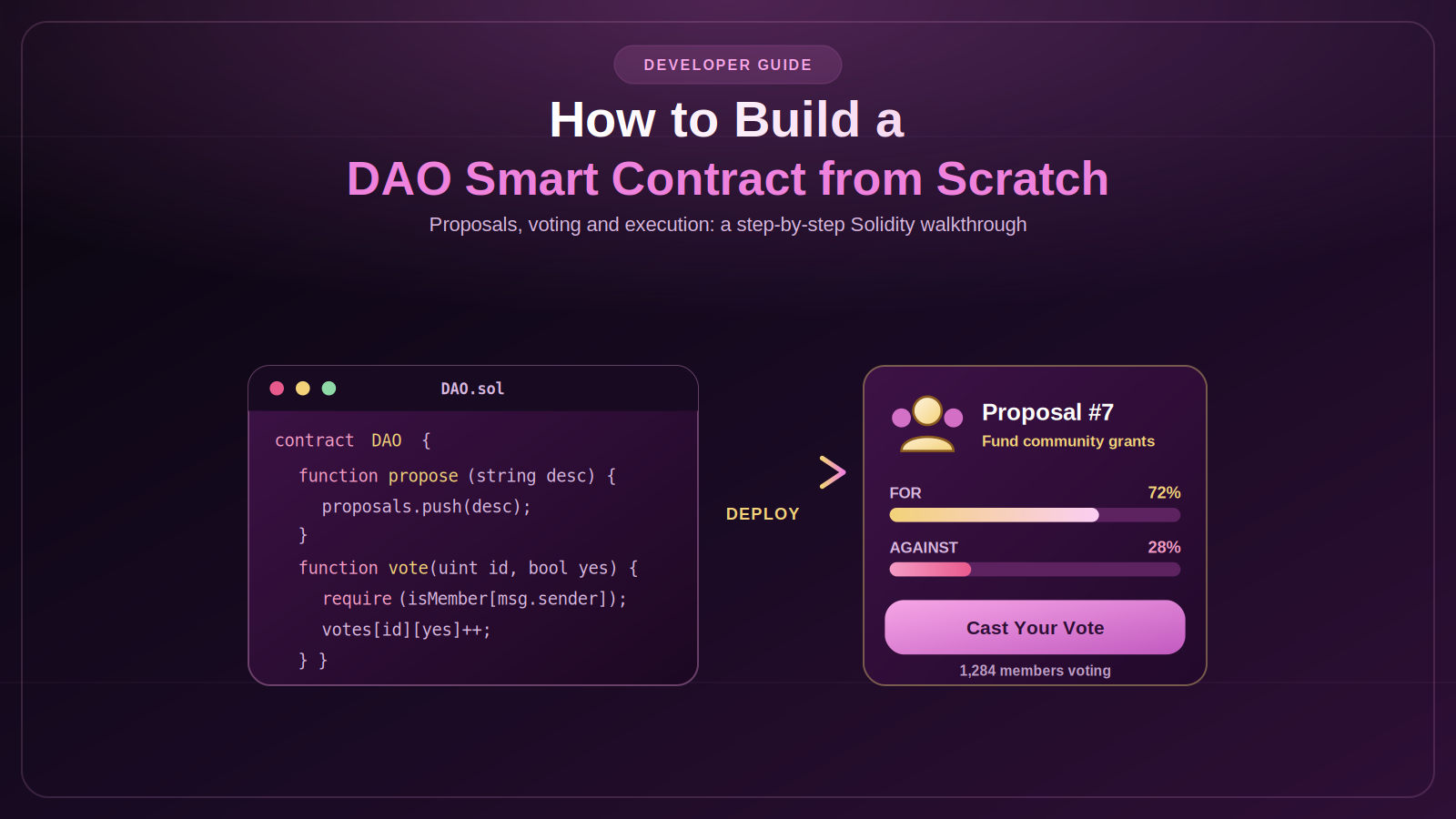
Decentralized Autonomous Organization (DAO) employs rules and smart contracts in blockchain technology for decision-making, management of common funds, and participation in governance by its members. As opposed to total dependence on a central authority, DAO may utilize rules that govern the process of creating, voting, and implementing proposals.
Creating a DAO smart contract involves much more than just coding a voting mechanism. There are many factors to be taken into account – membership, proposals, voting power, execution, security, and treasury management.
Let’s see how to do it.
What is a DAO Smart Contract?
DAO smart contracts consist of programs built in the blockchain that enforce the rules of an organization.
Some functions of a basic DAO include:
- Proposing governance proposals
- Voting on such proposals
- Monitoring the voting results
- Implementing decisions made
- Managing a treasury
- Defining the governance participants
An example of this would be when a DAO votes to approve moving a certain number of tokens from its treasury to an authorized participant.
Step 1: Define the DAO’s Governance Rules
Before writing code using Solidity, decide how the DAO will function.
There needs to be certain rules set like:
Who can submit a proposal?
Who is allowed to vote?
How is voting weight determined?
How long does the vote last?
What is the percentage required for the proposal to pass?
Is there a quorum needed?
Can voting weight be delegated?
How are successful proposals implemented?
For instance, one can make the rule that there needs to be more than 50% in favor of a proposal but also requires 10% of the total voting weight of the DAO.
These decisions become the foundation of your smart contract.
Step 2: Choose Your Blockchain
- DAO contracts usually operate on blockchain platforms that have the capability to execute smart contracts.
- There is Ethereum, which is one, but Base, Arbitrum, Optimism, and Polygon are equally good choices.
- This choice will have impacts on price, efficiency, developer environment, and the ecosystem your DAO will be able to interact with.
- In order not to jump into implementation right away, it is best to start with a testnet.
Step 3: Set up your Solidity Development Environment
For an Ethereum-compatible DAO, Solidity is one of the main programming languages you can use. Development environments such as Hardhat or Foundry can help you write, compile, test, and deploy contracts.
Step 4: Create the Membership or Governance Token
In many cases, voting rights in DAOs are defined using tokens.
For instance, if one has 100 governance tokens and the other has 50 governance tokens, the first one can have double the voting power compared to the second one.
The governance token may usually adhere to a token standard like ERC-20 on Ethereum-based networks.
Nevertheless, there arises a question related to token-based voting, which is when is the right time to calculate the voting power?
For instance, if one calculates voting power based on the user’s balance, that person can buy tokens just before voting and later sell them.
Step 5: Build the Proposal System
The proposal contract must specify how governance decisions will be incorporated into the process.
The proposal should include the following information:
- Proposal ID
- Proposer
- Description/Metadata Reference
- Target Contract
- Function Call
- Parameters
- Deadline for Voting
- Vote Count
- Execution Status
As one example, the proposal could state:
Transfer 1,000 governance tokens approved from DAO treasury to the desired address.
The proposal is stored in the contract and members are offered the chance to vote.
Step 6: Implement Voting
The voting mechanism is the core of DAO governance.
A basic system could provide three choices:
- For
- Against
- Abstain
When a member votes, the contract records the vote and prevents the same voting power from being counted repeatedly for that proposal.
Step 7: Add Quorum and Approval Rules
Voting percentages alone may not be enough.
Imagine a DAO has 100,000 tokens but only 100 tokens participate in a vote. If 60 tokens support a proposal, simply looking at the votes cast could make it appear successful even though participation was extremely low.
A quorum requires a minimum amount of voting participation before a proposal can pass.
For example:
- Total voting power: 100,000
- Required quorum: 20%
- Minimum participation: 20,000
You can then define the approval threshold separately.
This creates two conditions:
Quorum reached + required approval threshold = proposal can pass
The exact parameters depend on the DAO’s governance design.
Step 8: Create Proposal Execution
Votes have no value unless there is an action that is a consequence of approving a particular proposal.
A DAO can implement an execution function to verify that:
- The voting is completed
- The quorum condition is met
- The proposal is supported enough
- The proposal has not yet been executed
Only when all of these criteria are met will the smart contract conduct the proposed action.
In cases of treasury proposals, this may mean interacting with some other smart contract or transferring assets.
Execution must be appropriately limited since it is precisely this phase in which the consequences of governance decisions affect the DAO treasury.
Step 9: Secure the DAO Treasury
A DAO may eventually control tokens, stablecoins, NFTs, or other blockchain assets.
Treasury management therefore deserves additional safeguards.
Useful controls can include:
- Multi-signature approvals
- Spending limits
- Timelocks
- Emergency pause mechanisms
- Proposal execution delays
- Restricted contract interactions
- Clear access-control rules
A timelock, for example, can create a delay between an approved proposal and its execution. This gives participants time to review a potentially harmful or unexpected decision.
Step 10: Test the Smart Contract
Do not trust that a DAO contract will be secure just because it passes compilation.
Test the contract for both legitimate and malicious uses.
Test if:
- Unauthorized users can propose and execute proposals
- Users can vote multiple times
- The voting can proceed past the deadline
- Quorum calculations are working properly
- Failed proposals can be executed
- Successful proposals can be executed twice
- The treasury funds can be accessed without authorization
- Unintended contract calls can be made
You should also test corner cases like 0 votes, expired proposals, token transfer, and changing balances of voters.
If the DAO manages significant money, a third-party security audit of the smart contract is strongly recommended.
Step 11: Deploy and Monitor
Once testing is complete, deploy the DAO contract to a testnet and run the complete governance process.
Create a proposal, vote on it, wait for the voting period to finish, and execute it.
After the system behaves as expected, you can consider a mainnet deployment.
Deployment is not the end of the process. Monitor governance activity, contract interactions, treasury transactions, and unusual voting patterns after launch.
In a Nutshell
Designing a smart contract for a DAO means coming up with a contract design and a corresponding governance structure for it. A smart contract should specify who will be allowed to participate, how votes work, when proposals will get passed, and how accepted proposals will be enforced.
If you are doing this as a learning exercise, it is good to start with something like a voting contract using tokens. With time, you will be able to add functionalities such as delegation, snapshots, timelocks, treasury management, and multi-signature security.
Above all, do not treat governance code like any other application code. If the smart contract manages the DAO treasury, the contract has economic value, and any bug in its logic or access control could have permanent implications.
FAQs
Which programming language is used for creating a DAO smart contract?
There are many languages that you could use to create your smart contract, but Solidity is considered to be one of the most popular ones for DAOs that are built on the Ethereum network.
Development frameworks, including Foundry and Hardhat, may be employed for testing and deployment.
Should I have a governance token to create a DAO?
No, but this is just one of the ways to do so. In reality, there are many possible membership and voting schemes within the DAO. The governance token is the easiest way to assign voting rights because it utilizes blockchain ownership.
How does voting take place in a DAO?
The members get their voting rights according to the governance scheme. They can then vote on proposals during a certain voting period. When the voting is done, the smart contract verifies the voting conditions and only after that executes the accepted proposal.
Can I create my own smart contract for my DAO?
Yes, you can do that, although you must keep in mind that smart contracts need testing. If your DAO is going to be responsible for actual assets, it is recommended that you use existing and tested parts when possible.