


How to Build a “Buy Me a Coffee” DeFi DApp
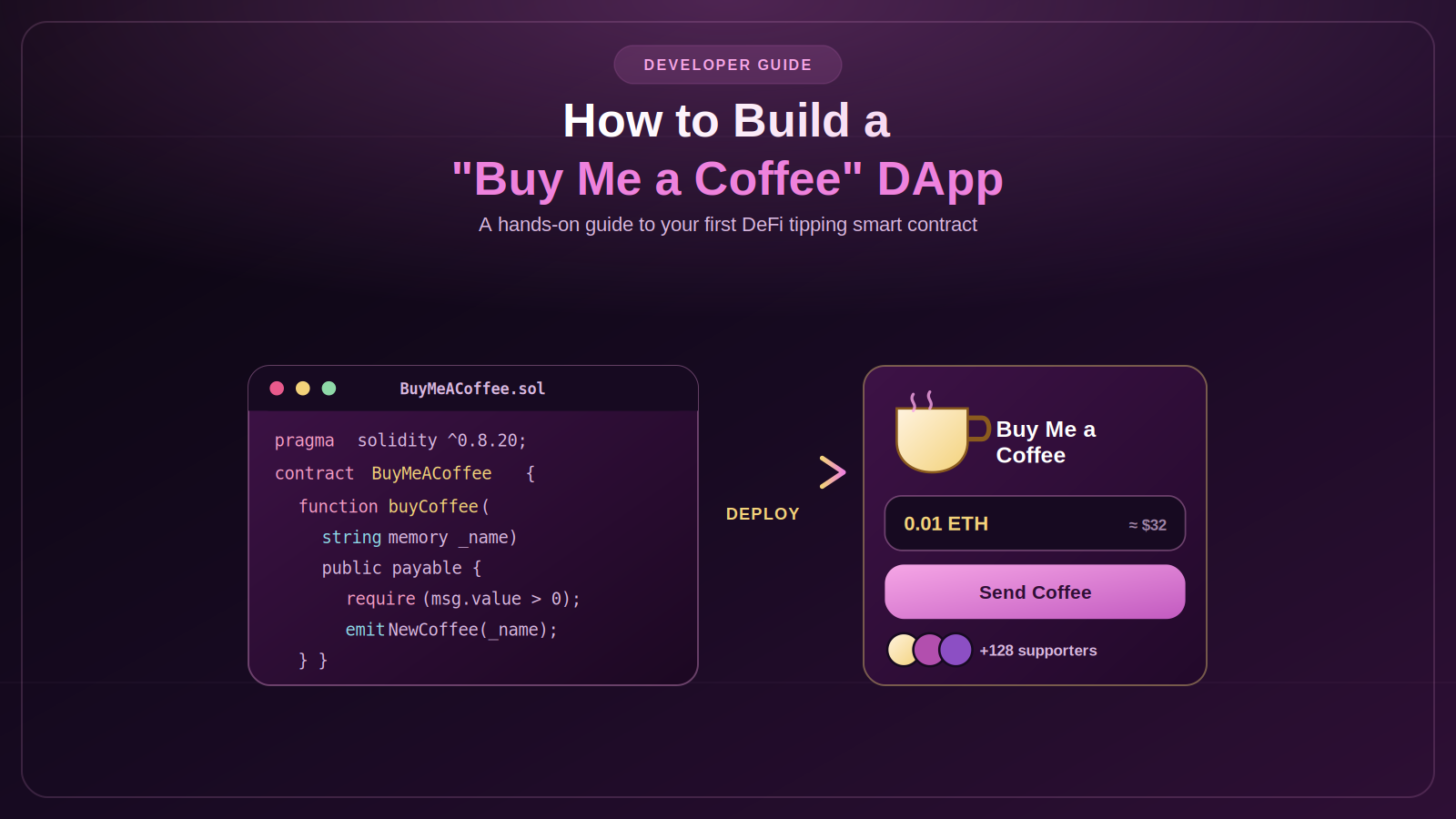
“A Buy Me a Coffee” DeFi DApp is a decentralized implementation of a system that allows users to make direct payments of cryptocurrency to creators, artists, developers, writers, or any person. Using blockchain technology, this DeFi DApp does not require any payment processing services to facilitate the transparent and peer-to-peer payments between people.
Development of such applications requires skills in blockchain, smart contract writing, integrating wallets, and designing the frontend for users to connect wallets and pay the selected amount of cryptocurrency to a certain person.
What is a “Buy Me a Coffee” DeFi DApp?
In a classic creator funding platform, fans can transfer money to fund someone’s creation. In a decentralized finance (DeFi) system, it is replaced by blockchain-based money transfer services.
The DApp enables the creators to create an individual payment page, while the supporter links their wallet and sends cryptocurrency to the creator’s page. Transactions can be automated with the use of smart contracts that will record all the transaction details on the blockchain.
The DApp can support various functionalities depending on the project objectives.
How does it work?
The application consists of three main parts: the frontend, smart contract, and blockchain.
The frontend serves as an interface for viewing the creators’ profile and making payments. The smart contract takes care of the payment logic that is pre-defined, and the blockchain deals with the transactions and ownership data.
A common sequence of events starts from connecting the crypto wallet by the supporter. They choose a creator and an amount to be paid and confirm the transaction.
Steps to build the DApp
1. Define Features
Start by determining what your application needs to accomplish.
Core features can include creator profiles, wallet connections, payment buttons, transaction histories, messages, and payment notifications.
You can later introduce advanced functionality such as stablecoin payments, recurring contributions, creator dashboards, and supporter badges.
2. Choose Blockchain
Select a blockchain based on transaction fees, speed, ecosystem, wallet support, and developer tools.
Ethereum provides a mature ecosystem, while Layer 2 networks and other compatible chains can offer lower transaction costs. Your choice will influence smart contract development, wallet integration, testing, and deployment.
3. Design Smart Contract
The smart contract is responsible for handling payments according to the application’s rules.
For a basic implementation, the contract can receive cryptocurrency and transfer it to the intended creator. It can also record payment information such as sender, recipient, amount, and timestamp.
Use established development libraries and follow secure smart contract practices rather than implementing complex financial logic unnecessarily.
4. Develop Frontend
Create an intuitive interface that makes supporting a creator as simple as possible.
The homepage can showcase creators, while individual pages can display their profile, description, contribution options, and recent activity.
Popular Web3 development frameworks can be used to connect the frontend with blockchain infrastructure and wallet providers.
5. Add Wallet Connection
Wallet connectivity is essential because users need a blockchain wallet to authorize payments.
The DApp should allow users to connect compatible wallets and clearly display the connected network and wallet address. Before a transaction is submitted, show the recipient and amount so users can verify the payment.
Never request private keys or wallet recovery phrases.
6. Implement Payments
Add the payment functionality through the smart contract. Users should be able to choose a predefined contribution amount or enter a custom amount.
Once they approve the transaction through their wallet, the blockchain processes the payment. The interface should provide clear pending, successful, and failed transaction states.
7. Add Creator Profiles
Creator profiles make the platform more useful than a basic payment contract.
Each profile can include a name, biography, profile image, social links, and preferred contribution amounts. A unique profile URL can allow creators to share their payment page directly with their audience.
8. Test Thoroughly
Deploy the smart contract to a test network before using a production blockchain.
Test wallet connections, payments, incorrect amounts, failed transactions, network changes, contract permissions, and withdrawal functionality.
Smart contracts handling significant funds should also undergo professional security review or auditing before launch.
Benefits of a DeFi Support DApp
- Blockchain enables supporters to send funds directly to creators without requiring a traditional payment intermediary.
- Crypto payments can potentially allow supporters and creators in different countries to interact without relying on the same local payment infrastructure.
- Blockchain transactions are publicly verifiable on supported networks, providing an auditable record of payments.
- A simple wallet-based payment flow can make small digital contributions accessible to users already participating in Web3.
- Creators can receive funds directly to their blockchain wallets and maintain greater control over their payment infrastructure.
Where can you use it?
- Writers, video creators, podcasters, and bloggers can accept direct contributions from their audiences.
- Developers can receive voluntary support for maintaining open-source projects and software.
- Digital artists can use contribution pages alongside NFT sales and other Web3 monetization methods.
- Online communities can use the model to support moderators, educators, organizers, or independent contributors.
- Decentralized organizations (DAOs) can use contribution mechanisms to fund community initiatives or individual contributors.
What you should keep in mind
Blockchain fees, smart contract security, wallet integration, failure handling, and regulations that may apply to financial applications in some jurisdictions need to be considered when building a production DApp.
Then there is user experience. The terminology used on blockchains can sometimes be confusing, so transaction fees, network choice, and wallet confirmation should be explained using clear terms.
Developing a “Buy Me a Coffee” Decentralized Finance DApp requires putting together frontend user interface, secure smart contracts, and blockchain technology. The basic steps include choosing features, selecting a network, building and testing smart contract, wallet integration, adding payment feature, and creator accounts.
This idea can be extended beyond tipping. Some additional features will allow creating a wider ecosystem for supporting creators in Web3.
FAQs
What is a “Buy Me a Coffee” DeFi DApp
It is a decentralized application that allows users to support creators through cryptocurrency payments using blockchain technology and smart contracts.
Which blockchain is best for this DApp?
There is no single best blockchain. Ethereum offers a mature ecosystem, while Layer 2 networks and other chains can provide lower transaction costs and faster confirmations.
Can users pay with stablecoins?
Yes. A DApp can be designed to support compatible stablecoins, provided the smart contract and wallet infrastructure are built to handle the selected tokens.
Is a DeFi payment DApp secure?
Security depends on the smart contract, frontend, wallet integration, and overall infrastructure. Thorough testing, established libraries, access controls, and professional audits can help reduce security risks.