


How to Create a DeFi Yield Farming Smart Contract
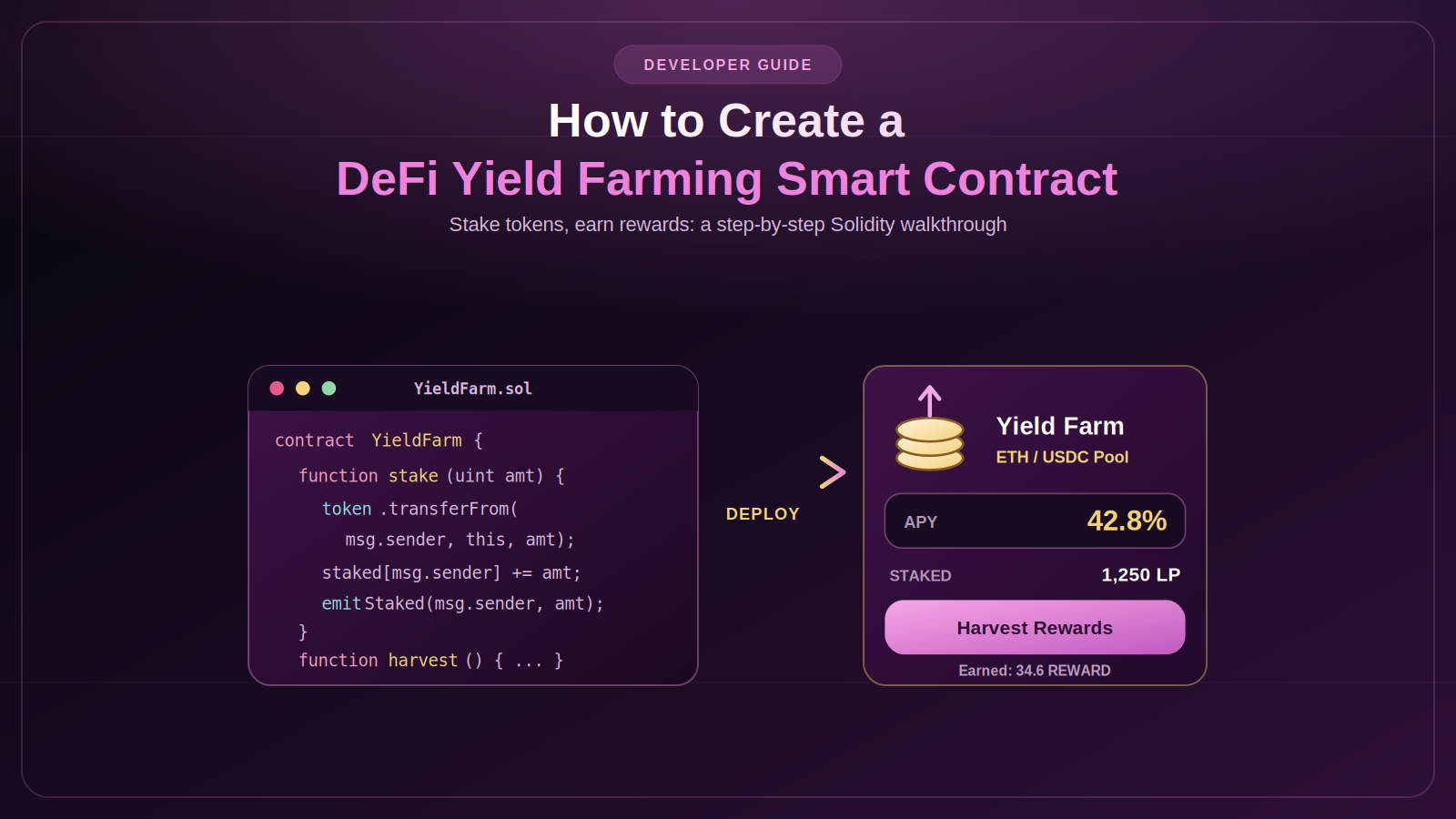
Decentralized Finance has transformed the way users engage with financial services through elimination of applications of yield farming that enable the user to stake digital assets in liquidity pools and receive rewards according to set rules.
DeFi Yield Farming Smart Contract handles all these processes automatically. The contract is able to handle deposits, liquidity management, rewards calculation, withdrawals, and distribution of farming incentives without human involvement. For the developer, creation of such a contract entails use of traditional intermediaries through blockchain technology. Understanding of Solidity, token standards, rewards distribution mechanism, and security of smart contract forms one of the most popular DeFi concepts.
The following guide outlines the steps involved in development of DeFi Yield Farming Smart Contract.
The Problem Yield Farming Smart Contracts Solve
The conventional financial system relies significantly on central organizations for the management of deposits, calculation of returns, and distribution of profits. This approach adds more intermediaries, costs, and time delays.
DeFi applications solve these problems by embedding all the financial functions directly into the blockchain. But manual management of many liquidity providers becomes difficult in such cases. The use of smart contracts makes this process automatic, as it automatically tracks deposits, divides users’ shares, and distributes rewards according to the algorithm.
The key task here is to ensure correct calculations by the contract and security of deposits against possible risks.
Steps to Create a DeFi Yield Farming Smart Contract
1. Define the Farming Model
Start by determining how the farming protocol will operate.
Define:
- Deposit and reward tokens
- Reward emission rate
- Farming period
- Minimum deposit
- Withdrawal conditions
- Lock-up periods, if applicable
- Reward calculation method
- Emergency withdrawal rules
The economic model should be designed before writing the contract because reward distribution directly affects the sustainability of the protocol.
2. Set Up the Development Environment
Ethereum-based yield farming contracts are generally implemented using the Solidity language.
The implementation of the contract can be done using the help of the compilers such as Hardhat or Foundry. OpenZeppelin libraries may offer ready-to-use code for commonly used modules in smart contracts.
Start with implementing the contract on a local blockchain first.
3. Implement Token Deposits
The deposit function helps in allowing the user to deposit tokens to the farm contract.
Generally, the users first allow the smart contract to spend the specific tokens of the user. The deposit operation then deposits the tokens for the user and updates the user’s balance.
The contract should keep track of variables like the following:
- Amount deposited by the user
- Total balance of the pool
- Reward accounting information
- Last time of updating rewards
4. Create the Reward Calculation Mechanism
The calculation of rewards is one of the crucial aspects of the contract.
There can be a simple calculation of a model which will take into account pool share, reward rate, and the time of deposit of the user. But the calculation of rewards for each individual participant separately can make the process less efficient.
For more complicated yield farming contracts, there exists the concept of an accumulated reward per share.
This approach helps to calculate rewards for each individual participant without going through all the participants one by one.
It is essential to test the accounting system not to allow users to get more or less rewards.
5. Add Reward Claiming
Users need a function that allows them to claim accumulated rewards.
When the claim function is called, the contract calculates the user’s pending rewards and transfers the available reward tokens to their wallet.
The user’s reward accounting should be updated before external token transfers. Following established smart contract security patterns can help reduce potential vulnerabilities.
6. Implement Withdrawals
The withdrawal function allows users to retrieve their deposited tokens.
Before processing the withdrawal, the contract should update the user’s pending rewards and balance. It can then transfer the deposited assets back to the user’s wallet.
If the protocol uses withdrawal fees, penalties, or lock-up periods, these conditions should be clearly incorporated into the contract and communicated to users.
7. Add Access Control and Emergency Features
Some administrative functions may be necessary for managing the protocol. These could include setting reward parameters, funding the reward pool, or pausing the contract during an emergency.
Access to these functions should be restricted using secure role-based permissions.
An emergency withdrawal feature can also provide users with a way to retrieve their deposited assets if normal farming operations need to be paused.
Security Considerations
A yield farming contract directly handles user assets, making security critical.
Developers should consider potential risks such as:
- Reentrancy attacks
- Unauthorized access
- Incorrect reward calculations
- Token transfer failures
- Manipulation of reward parameters
- Poor access-control design
- Vulnerabilities in external contracts
Using established libraries, following recognized security patterns, and keeping the contract architecture simple can help reduce these risks.
Testing and Auditing
Before deployment, the contract should be tested under different conditions.
Developers should test deposits, withdrawals, reward claims, multiple users, zero balances, reward-rate changes, farming-period completion, and emergency withdrawals.
Automated testing, fuzz testing, and static analysis can help identify unexpected behavior. For contracts handling substantial user funds, an independent security audit is strongly recommended.
Benefits of a Yield Farming Smart Contract
Yield farming contracts offer several advantages:
Automation: Deposits and rewards are processed according to predefined rules.
Transparency: Transactions and contract logic can be inspected on the blockchain.
Accessibility: Users can participate without relying on traditional financial institutions.
Programmability: Developers can create customized reward mechanisms.
Efficiency: Automated calculations reduce the need for manual management.
Challenges to Consider
Despite their benefits, yield farming protocols have risks. Smart contract vulnerabilities can result in financial losses, while poorly designed token economics can make reward systems unsustainable.
Reward tokens may also experience significant price volatility. Additionally, users may face liquidity risks, impermanent loss in certain liquidity pool models, and blockchain transaction costs.
Therefore, both technical security and economic sustainability should be considered before launching a farming protocol.
Creating a DeFi yield farming smart contract involves designing the farming model, developing deposit and withdrawal mechanisms, implementing accurate reward calculations, adding access controls, and thoroughly testing the system.
The development process should prioritize security and transparent economics because the contract may handle significant user funds. With proper development practices, testing, and auditing, smart contracts can provide an automated foundation for decentralized yield farming applications.
What is a DeFi yield farming smart contract?
It is a blockchain-based program that manages user deposits and automatically calculates and distributes farming rewards according to predefined rules.
Which language is commonly used to create yield farming contracts?
Solidity is commonly used for yield farming contracts deployed on Ethereum and other EVM-compatible blockchains.
How are yield farming rewards calculated?
Rewards can depend on factors such as deposited amount, pool share, reward emission rate, and time. Advanced protocols often use reward-per-share accounting for efficient distribution.
Should a yield farming smart contract be audited?
Yes. Thorough testing and an independent security audit are strongly recommended, particularly when the contract will manage significant amounts of user funds.