


What is a Crypto Bridge? How Cross-Chain Bridging works
Crypto ecosystem comprises various blockchain networks with unique infrastructure, tokens, applications, and protocols. Bitcoin works in a distinct way from Ethereum, whereas blockchains like Polygon, Arbitrum, and Avalanche have distinct ways of processing their transactions. Such an architecture may hinder movement of tokens between various blockchains.
A crypto bridge, alternatively known as a blockchain bridge, is a mechanism used by blockchain networks to facilitate exchange of assets and data from one blockchain network to another. Bridges ensure that various blockchain networks are interoperable through the provision of cross-chain functionality.
Why do Blockchain Networks need Bridges?
- Blockchain systems are mostly independent ecosystems. An asset created using one blockchain cannot be used automatically in another blockchain system.
- For instance, an Ethereum token will not be created by default on platforms like Arbitrum and Avalanche. A bridge can offer the means through which the asset can be represented on another compatible network.
- This feature can be useful in transferring the assets into a platform with lower transaction fees or faster transactions.
- In the absence of bridges, one will have to use third-party services like centralized exchanges to transfer assets.
What does a Crypto Bridge actually do?
A bridge usually helps facilitate the transfer or representation of any assets from one blockchain network to another.
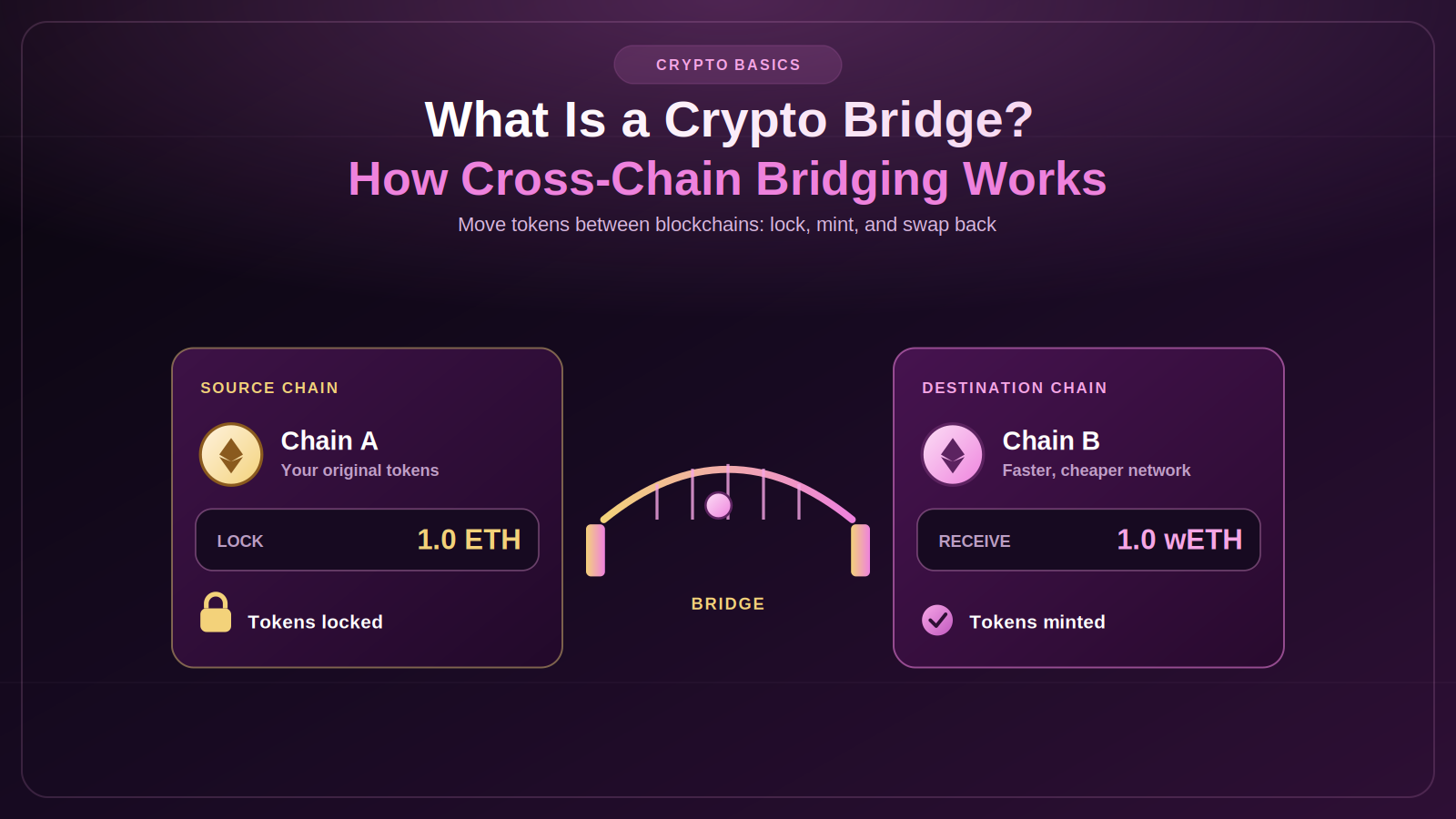
If there is a need to transfer any asset from Blockchain A to Blockchain B, the bridge will first lock or somehow represent the asset on Blockchain A and issue a representation of that asset on Blockchain B.
Once the user intends to revert back to Blockchain A, the bridge will again undo the whole process.
This process changes from one bridge to another.
How Cross-Chain Bridging works
Although different bridges use different architectures, a simplified bridging process can look like this:
Step 1: Connect Your Wallet
The user connects a compatible crypto wallet to the bridge interface and selects the blockchain they are sending assets from and the blockchain they want to use as the destination.
Step 2: Select the Asset
The user chooses the cryptocurrency or token they want to transfer and enters the amount.The bridge calculates applicable network fees and other transaction costs.
Step 3: Lock or Deposit the Asset
The user sends the asset to a smart contract or designated address on the source blockchain.
Depending on the bridge architecture, the original asset may be locked, deposited, burned, or otherwise accounted for.
Step 4: Verify the Transaction
The bridge’s infrastructure detects the transaction and verifies that the required conditions have been met.
This verification can be performed through smart contracts, validators, relayers, or other mechanisms.
Step 5: Receive the Asset on the Destination Chain
Once the transaction is verified, the corresponding asset can be released, minted, or transferred to the user’s wallet on the destination blockchain.
The user can then interact with applications on that network.
Different types of Crypto Bridges
Bridges can also be categorized according to how they are operated.
Trusted Bridges
Trusted bridges depend on specific entities, validators, or operators to facilitate cross-chain transactions.
Users may need to trust these parties to correctly manage assets and process transactions.
Trust-Minimized Bridges
Trust-minimized bridges attempt to reduce reliance on centralized intermediaries by using smart contracts, cryptographic verification, decentralized validators, or blockchain-based verification mechanisms.
However, “trust-minimized” does not mean risk-free. Users still depend on the bridge’s code and underlying security model.
Native Asset Bridges
Some bridges facilitate transfers involving assets that have native versions on different networks or are specifically designed for cross-chain interoperability.
The mechanism depends on the participating networks and the bridge architecture.
Why do people use Crypto Bridges?
Cross-chain bridges can provide several practical benefits.
- Access to different ecosystems: Users can move assets to networks supporting different decentralized applications.
- Potentially lower transaction costs: Users may move assets from a congested network to one with lower fees.
- Greater liquidity: Bridges can connect liquidity across different blockchain ecosystems.
- DeFi opportunities: Users can access lending, decentralized exchanges, yield platforms, and other applications on multiple networks.
- Blockchain interoperability: Bridges contribute to a more connected multi-chain ecosystem.
The Future of Cross-Chain Technology
With more and more blockchain networks emerging, interoperability has been a major field of development.
In the future, cross-chain technologies will be based on more sophisticated methods of messaging, cryptography, interoperability standards, and validation.
The ultimate purpose is to ensure that different blockchain networks are interoperable without having to worry about each level of technology utilized in the transfer process.
FAQ
What is a crypto bridge?
A crypto bridge is a system that enables assets or information to move between different blockchain networks. It can use mechanisms such as locking, minting, burning, or transferring tokens across chains.
Are crypto bridges safe?
Crypto bridges carry risks because they depend on smart contracts and other technical infrastructure. Their security varies significantly, so users should research the bridge’s architecture, audits, security history, and official contract addresses before using it.
Does bridging a crypto asset sell it?
Usually, no. Bridging generally involves transferring or creating a representation of an asset on another blockchain rather than selling it for fiat or another cryptocurrency. The exact process depends on the bridge.
Why are crypto bridges important?
Crypto bridges help connect separate blockchain ecosystems. They allow users to access applications, liquidity, and services across multiple networks without relying exclusively on centralized exchanges.