



What is Liquid Staking? Lido, Rocket Pool, and How it differs from Regular Staking
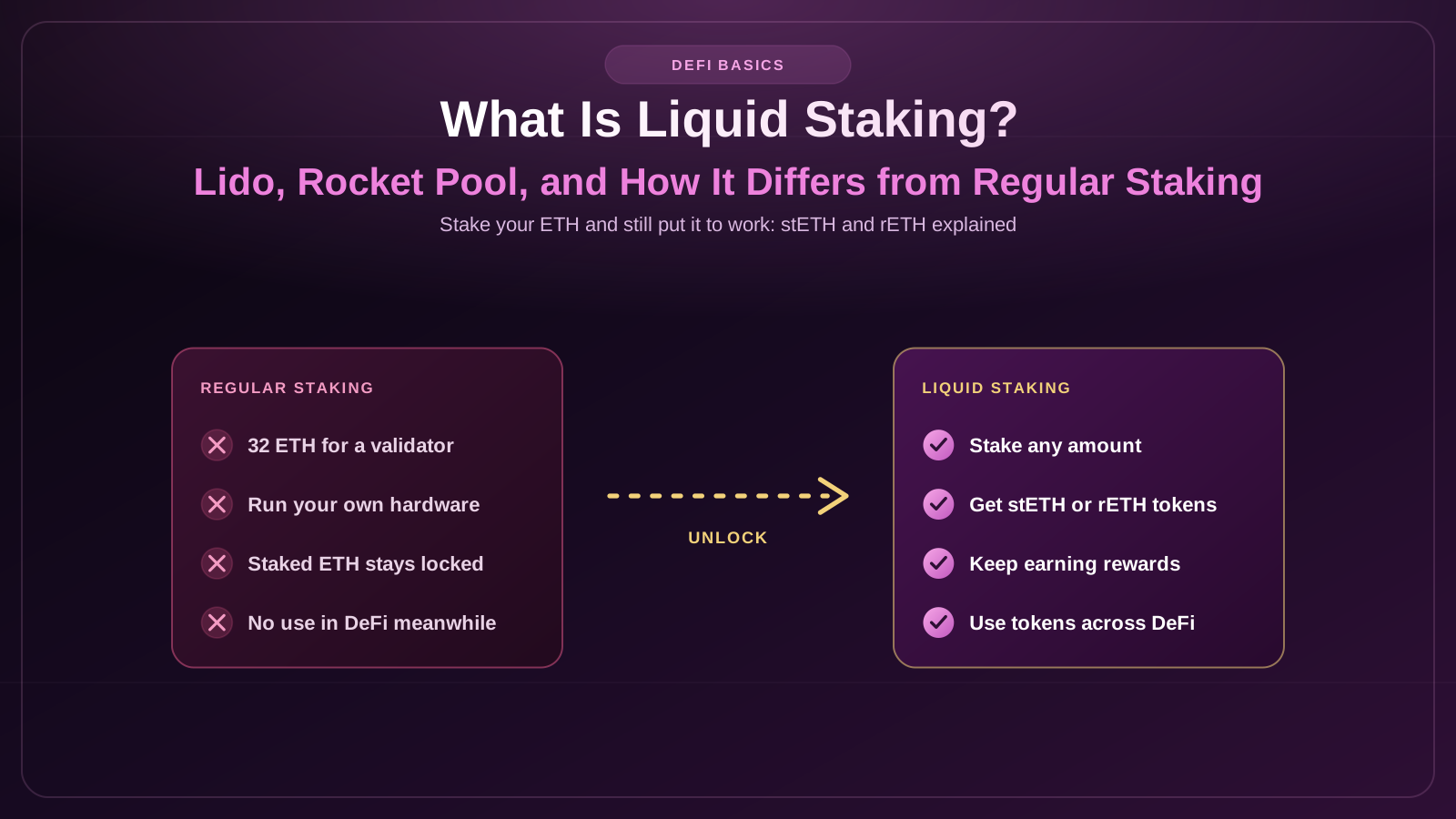
Liquid Staking refers to the procedure in which crypto asset owners stake their holdings and get a tradable token that represents their staked position.
With conventional staking, crypto assets are locked up by the users to contribute to the proof-of-stake system of blockchain in order to earn rewards, but the crypto assets can only be unlocked when un-staking or withdrawal takes place.
Liquid staking, on the other hand, provides a solution to the problem by giving the user a Liquid Staking Token (LST) in exchange for the asset deposited. The user will keep getting rewards as well as have a tradable token. For instance, if someone is staking ETH using the liquid staking platform, they will receive stETH or rETH tokens in return.
How does Liquid Staking work?
In Liquid Staking, we have the staking protocol, smart contracts, and the network of validators.
This is the procedure that is normally followed:
- The user deposits ETH in the liquid staking protocol, which could be Lido or Rocket Pool, among others.
- The liquid staking protocol delegates the deposited ETH to validators for participation in the Ethereum Proof-of-Stake network.
- A user gets a liquid staking token in return for their position.
- Validator earns rewards from participating in the network activities. These rewards will show up in the value or balance of the liquid staking token.
- Users can keep, trade, or even use their LSTs as collaterals in the DeFi applications that support them.
By doing this, one is able to retain exposure to the staked assets without having to run their own validators network.
Note that Liquid staking is not a built-in feature of Ethereum.
What is Lido?
Lido is one of the most widely used liquid staking protocols in the Ethereum ecosystem. It allows users to deposit ETH and receive stETH, a token representing their staked ETH and associated staking rewards.
How Lido Works
- Once users stake their ETH with Lido, stETH tokens will be generated from the protocol.
- The deposited ETH is aggregated and allocated to validators via the staking mechanism of Lido.
- Reward allocation by the protocol includes taking into account fees and the possibility of validator penalties.
- Rebasing is another key characteristic of stETH. It implies that the balance of the stETH token held in the user’s wallet grows due to the rewards received.
- As a result, if a user receives 1 stETH at the start, it will be possible to accumulate more as rewards come.
- StETH can be swapped for other cryptocurrencies via available exchanges and withdrawal can be requested using Lido’s withdrawal mechanism.
What is Rocket Pool?
Rocket Pool integrates user deposits with the ETH provided by its own node operators. The node operators provide the necessary infrastructure for running Ethereum validators and are paid out for their service.
The users are issued rETH for their deposits. Unlike the rebasing stETH by Lido, rETH retains the same token balance as its exchange value to ETH rises with staking rewards.
For instance, a person holding 1 rETH will continue to have 1 rETH with reward accumulation. Nevertheless, the token will be able to be exchanged for more ETH with time.
Key features of Rocket Pool:
- Issues rETH against deposited ETH.
- Uses a decentralized network of node operators.
- Allows users to participate without running their own validator.
- Reflects rewards through an increasing exchange rate.
- Supports rETH integration with compatible DeFi applications.
Liquid Staking vs. Regular Staking
Both models allow users to earn rewards while participating in Proof-of-Stake networks. However, what distinguishes the two models is what follows the user’s funds being used as collateral once staking is completed. For traditional Ethereum staking, users have to stake at least 32 ETH before activating the validator and managing all necessary infrastructure.
With Liquid Staking Pools, participants can get involved with fewer funds through a pooled contribution.
Benefits of Liquid Staking
- Tokens are provided to users as representation for the underlying assets that have been staked, thereby enabling the user to continue benefiting from staking rewards and use the tokens elsewhere.
- LSTs can be used in various DeFi services such as lending platforms, liquidity pools, etc. The opportunity exists for leveraging staked assets as collateral or even in DeFi operations.
- It is not necessary for the user to hold 32 ETH and run his/her own validator node for participating in liquid staking in Ethereum.
- The entire protocol takes care of the validator operations and enables participation by those users who lack the requisite technical knowledge to operate a node.
In a nutshell
Liquid staking enables a more versatile system of Proof-of-Stake consensus by allowing users to get tradable tokens that signify staked crypto. Lido and Rocket Pool offer two ways of doing that, respectively with stETH and rETH.
Although liquid staking allows for better capital efficiency and provides an opportunity to integrate staking with DeFi projects, it poses some smart contract, liquidity, and protocol risks on its own. It is important to understand how each particular protocol operates before staking.
FAQs
What is a liquid staking token?
A liquid staking token is an asset that is issued when users deposit their cryptocurrency in a liquid staking protocol. This way, the users receive their interest in the staked crypto and rewards.
What is the difference between stETH and rETH?
The stETH token from Lido employs the rebasing concept, whereby the balance of the token grows in tandem with the accumulation of rewards. The rETH token, issued by Rocket Pool, remains fixed in terms of its balance but grows in exchange for ETH.
Are liquid staking tokens useful for DeFi purposes?
Yes, they are. Supported LSTs may be traded, deposited to liquidity pools, or serve as collateral in any other DeFi application. Such activities come with extra risks.
Is liquid staking better than regular staking?
Not necessarily. Users choose between liquid staking and solo staking depending on their needs. Liquid staking offers flexibility and lower entry barriers, while solo staking provides greater control over validator operations and avoids liquid staking protocol risks. Neither approach is risk-free.