


What is Account Abstraction? How Smart Wallets are Changing Web3 UX
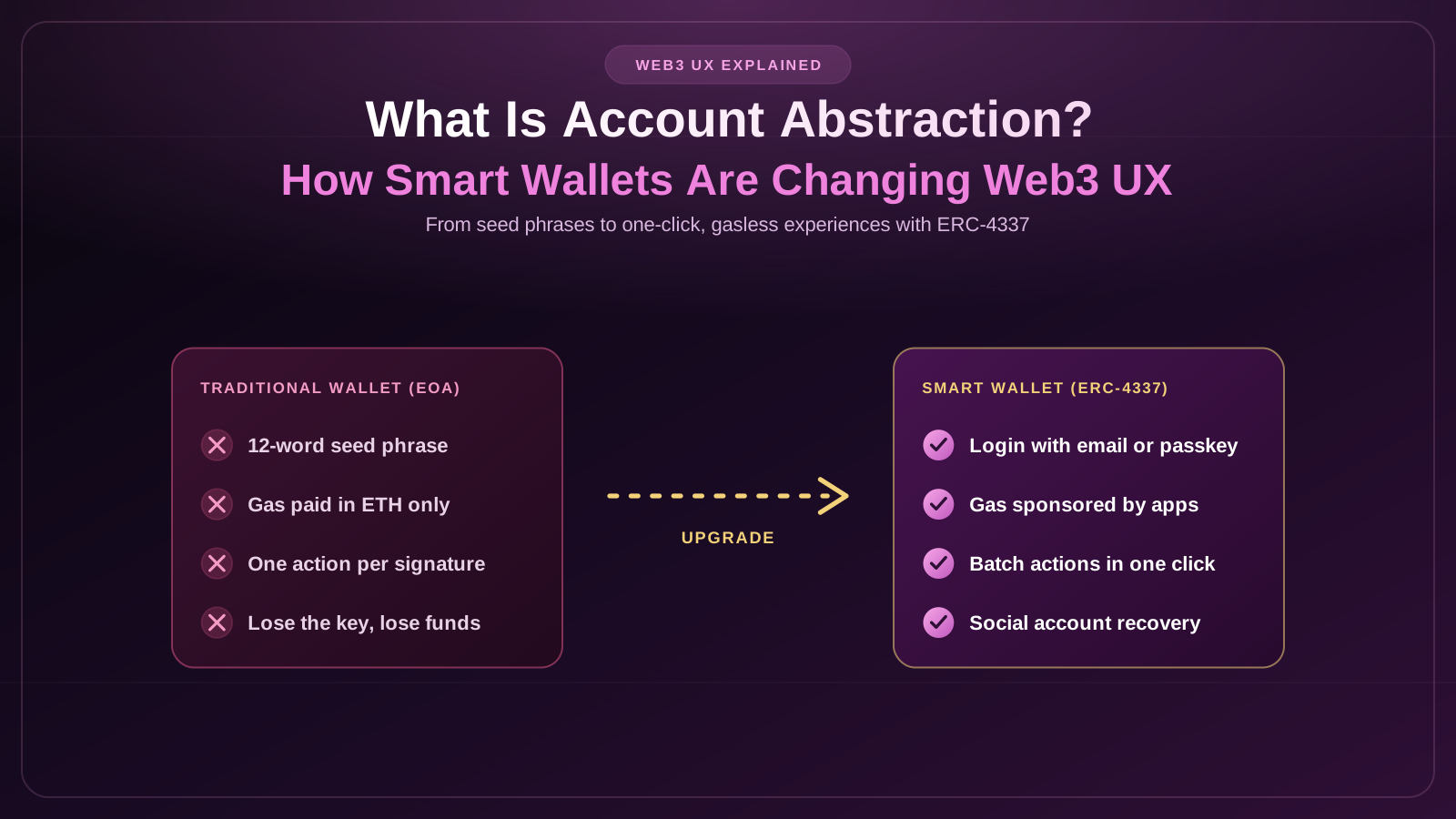
Account abstraction is an aspect of blockchains where accounts become programmable in that transactions authorization and execution become tasks for smart contracts.
Traditional Ethereum externally-owned accounts (EOAs) are based on private key control, where the user signs transactions directly using these private keys and has an account governed by protocols built into Ethereum.
In contrast, smart contract accounts can perform custom logic through which account abstraction gives developers of wallet applications the opportunity to do much more with these accounts.
An example of an account abstraction ecosystem for Ethereum is ERC-4337, where smart contract wallets can be created without altering Ethereum’s protocol.
Unlike using the externally-owned account paradigm alone, there is another way of interacting with wallets that supports customized transactional rules.
How does Account Abstraction work?
Account abstraction provides a new mechanism for structuring the transaction request, validation, and execution.
According to ERC-4337, the user can send the operation that is called UserOperation. The UserOperation specifies an intended action like token transfer or decentralized app interaction.
The operation is processed using a dedicated infrastructure instead of submitting a standard Ethereum transaction by the user’s EOA.
This is how the procedure generally looks like:
- The user starts an action using a smart wallet.
- The smart wallet makes a UserOperation that describes the intended transaction.
- Bundler gathers qualified operations and sends them to Ethereum as a bundle.
- The smart account verifies the operation based on the preset criteria.
- If the verification is successful, the account will perform the action.
It all takes place with the help of a special contract called the EntryPoint contract in ERC-4337 infrastructure. Paymaster may also cover fees for qualified transactions or let the users pay in other ways supported by the paymaster.
The actual experience will depend on the wallet implementation and the apps it integrates with.
What are Smart Wallets?
- Smart Wallets are wallets where transactions can be made according to the contract’s logic, and not only via a single private key to authorize everything.
- A Smart Wallet can require several signatures for big transactions, while smaller transactions will need a much simpler process of authorizing.
- Smart Wallets may be equipped with a feature of recovery, spending restrictions, and automatic workflow for transactions.
- But Smart Wallets also come with their particular issues since security of a smart wallet relies on contract’s code, authorization rules, recovery setup, etc.
Key Features of Account Abstraction
1. Gasless Transactions
Transactions on Ethereum traditionally involve paying gas fees in ETH. This may cause some inconvenience to people having other types of tokens but lacking sufficient ETH to pay for the transaction.
Account abstraction provides the capability of sponsoring transactions using paymasters. The DApp or sponsor may pay eligible transaction fees on behalf of the user.
There are also fee payment mechanisms in some implementations.
It becomes easier to onboard people into the system as they do not necessarily have to obtain ETH before engaging with a particular application.
2. Social Recovery
The inability to access one’s crypto wallet can pose an issue especially in case the user lacks their recovery phrase.
Social recovery could be possible in smart wallets as it would enable guardians or trusted contacts to aid in restoring the user’s access to their wallet based on predetermined criteria.
For instance, a wallet may require the consent of a certain number of guardians prior to replacing the controlling key.
This way, reliance on a recovery phrase is minimized, but this depends on how each smart wallet has set things up.
3. Transaction Batching
Traditional wallets may need to authorize individual transactions for each of the actions performed.
Smart wallets allow users to perform transactions in batches, which means executing several actions at once.
For instance, if a user is using a DeFi application, he/she will first have to authorize a certain token and make a deposit to the protocol. The smart wallet will bundle these actions into a single workflow.
However, it should be noted that batching does not guarantee reduced transaction fees.
4. Customizable Security Rules
Account abstraction enables wallet developers to introduce programmable spending and authorization policies.
Examples include daily spending limits, multi-signature approvals, session keys for temporary permissions, and additional checks for high-value transfers.
Session keys can be particularly useful for gaming and other applications that require frequent interactions. Instead of approving every action manually, a user can grant limited permissions for a defined period or set of activities.
These features can improve convenience while preserving controls over what the wallet is allowed to do.
Account Abstraction vs. Traditional Crypto Wallets
Traditional wallets are normally quite simple, but the user himself has to handle more of the transactional process manually. Smart wallets are capable of adding programmable capabilities which can help to automate these processes.
In the case of an ordinary EOA, the transaction signing usually occurs based on the private key associated with the address. In the case of smart wallets, transaction signing can occur using more complicated algorithms set in the account.
This comparison does not imply the inherent inferiority of ordinary wallets or superiority of smart wallets, as the latter have their own problems related to vulnerabilities in contracts or other infrastructure.
How Account Abstraction Is Improving Web3 UX
User experience has always been difficult for decentralized applications. For new users, it may be hard to understand seed phrases, network changes, gas fees, and multiple transaction confirmations.
Account abstraction is able to allow applications to solve user experience problems with onboardings, sponsorship of transactions, recovery, and easy multi-steps.
From the developer’s point of view, account abstraction offers possibilities of making applications where blockchain complications stay hidden from end-users.
For instance, it may be possible to sponsor small transactions in a Web3 game, and use session permissions in a decentralized finance application.
FAQs
What is account abstraction in cryptocurrency?
Account abstraction permits programmable authorization and logic for executing transactions with blockchain accounts. On Ethereum, standards like ERC-4337 provide smart contract wallets that support such capabilities as gas sponsorship, batching, and social recovery.
Is account abstraction the same thing as a smart wallet?
Not really. While account abstraction is the idea behind programmable account behavior, a smart wallet is a wallet based on smart contracts for managing transactions in a cryptocurrency account. Account abstraction is just one way to build advanced smart wallets.
Does account abstraction get rid of gas fees?
No. Blockchain transactions still require network resources and incur certain expenses. However, it becomes possible for apps and third parties to pay gas fees for users or to create some other fee payment model.
Are smart wallets safer than regular wallets?
They may provide some extra security features such as spending limits and social recovery. However, there are also some risks associated with using smart contracts in smart wallets.