


Tezos Tallinn Upgrade Now Live, Slashes Block Times to 6 Seconds
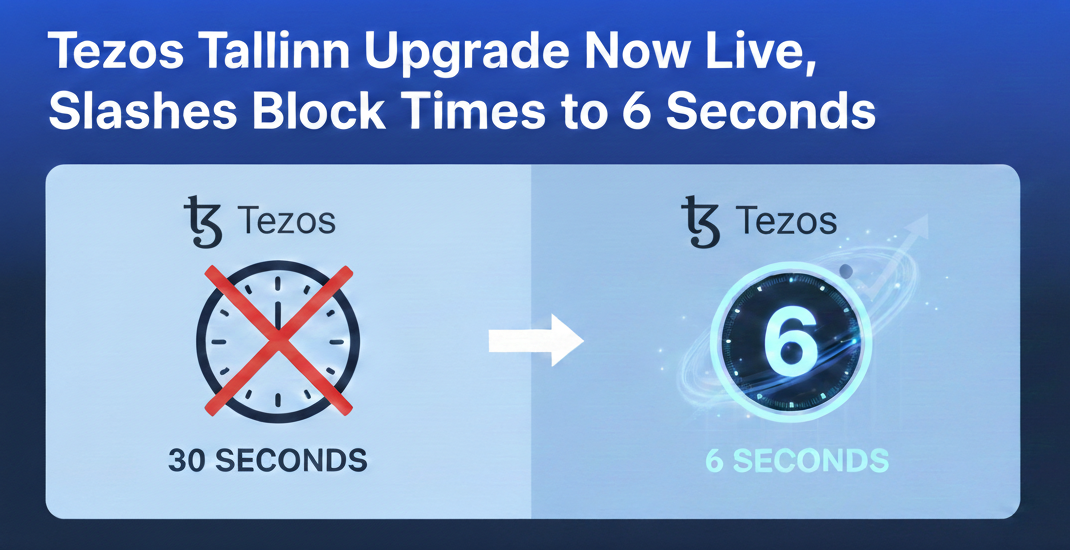
Tezos Tallinn is live: 6-second blocks, 100× storage gains
The Tezos blockchain has just hit a major milestone: its 20th protocol upgrade, Tallinn, is now live on Mainnet as of 24 January 2026. This is one of the most significant upgrades in recent Tezos history, and it’s a big deal in the world of crypto news, blockchain, and blockchain technology.
Now, Tezos L1 blocks are produced every 6 seconds instead of 8, with finality in just 12 seconds. That’s a noticeable speed boost for apps, NFTs, games, and DeFi, and it’s a clear signal that Tezos is serious about competing as a fast, low-cost Layer 1.
For anyone tracking crypto pur (the price of XTZ, adoption, and on-chain activity), Tallinn is a strong technical signal that Tezos is not stagnating, it’s optimizing for real-world use while keeping its on-chain governance model live and forkless.
What actually changed with Tallinn?
Tallinn isn’t just about block time; it’s a package of three major improvements that make Tezos faster, more secure, and way more efficient for developers:
- 6-second block time, 12-second finality
Tallinn cuts Tezos’ base-layer block time from 8 seconds down to 6 seconds. That means transactions confirm faster and the network finalizes in just 2 blocks (about 12 seconds) instead of 16.
For dApps, NFTs, and DeFi, this means snappier user experience and shorter wait times for critical actions like swaps, minting, and withdrawals. For Layer 2s like Etherlink, tighter L1 finality also improves the speed and security of cross-chain settlement. - All bakers attest every block (BLS + tz4 addresses)
Tallinn introduces BLS (Boneh–Lynn–Shacham) cryptographic signatures, which allow all validators (called “bakers”) to attest to every block rather than only a subset.
This change is tied to the adoption of tz4 consensus addresses; once ~50% of baker activity uses tz4, the network switches to this stronger mode, which improves security and reward predictability for stakers.
It also reduces the computational load on nodes, paving the way for future block time reductions without requiring more powerful hardware. - Address Indexing Registry (up to 100× storage efficiency)
Tallinn adds a new Address Indexing Registry that removes redundant address data from contract storage, slashing storage costs by up to 100 times for Michelson-based applications.
For large NFT projects, identity systems, and enterprise dApps that store many addresses, this is a game-changer — it means far lower on-chain storage fees and higher sustainable throughput.
Why this matters for blockchain and crypto pur
For the broader blockchain space, Tallinn is a strong case study in how a mature, on-chain-governed network can keep improving without hard forks and community splits.
- Tezos has now done 20 major upgrades since 2018, all via its own governance, and Tallinn is among the most impactful.
- The move to 6-second blocks brings Tezos into the same performance league as many other fast Layer 1s, but without sacrificing decentralization or the security model that’s kept Tezos stable for years.
For crypto pur watchers (XTZ price, staking, and on-chain usage), Tallinn should be seen as a strong technical catalyst:
- Faster blocks and lower fees make Tezos more competitive for retail dApps and NFTs.
- The 100× storage gains open the door to heavier, more complex apps that were previously too expensive to run on-chain.
- The BLS and baker changes improve the staking experience and could attract more institutional and enterprise-grade validation if governance participation stays high.
What Tallinn means for developers and apps
If you’re building on Tezos, Tallinn delivers real, measurable wins:
- Faster UX
With 6-second blocks, your dApp users experience shorter confirmation times. This is critical for trading, gaming, and any app where responsiveness matters. - Lower storage costs
The Address Indexing Registry is a game-changer for apps that store lots of addresses (e.g., NFTs, DAOs, identity systems). Contracts can now be built to be up to 100× more storage-efficient, which directly translates to lower gas fees and a lighter on-chain footprint. - Stronger security and sustainability
Universal baking/attestation improves network security and paves the way for future block time reductions. For teams running validator infrastructure, the lower node load from BLS aggregation also means less hardware strain and lower operational costs. - Better Layer 2 synergy
With L1 finality now achievable in 12 seconds, Layer 2 solutions like Etherlink can offer even faster user experience while still relying on a censorship-resistant, secure settlement layer.
What’s next for Tezos after Tallinn?
With Tallinn live, Tezos is not stopping. The upgrade is part of a broader roadmap focused on:
- Speed and finality
The 6-second block time is already a big jump, and the network is now technically ready for even shorter block times in future upgrades, as long as the community and bakers agree through governance. - Scalability and storage
The 100× storage efficiency gain is a foundation for heavier apps. Future features could build on the Address Indexing Registry to further optimize data handling and on-chain state. - Enterprise and institutional adoption
Lower node requirements, predictable finality, and strong on-chain governance make Tezos attractive for regulated institutions and enterprises that want a blockchain they can trust and upgrade without drama.
For crypto pur and blockchain watchers, Tarinas is a reminder that Tezos has not been asleep, it’s been quietly optimizing while other chains chase trends.
If you’re building on Tezos, now is the time to plan:
- Audit existing contracts to see how much storage savings the Address Indexing Registry can give you.
- Start testing with the new 6-second block time to see how it improves app UX.
- If running a baker, evaluate when to migrate to tz4 addresses so you can participate in the stronger consensus model.
Tallinn is live, and it’s a clear signal that Tezos is playing the long game in the blockchain technology race.