


What is Impermanent Loss in Crypto?
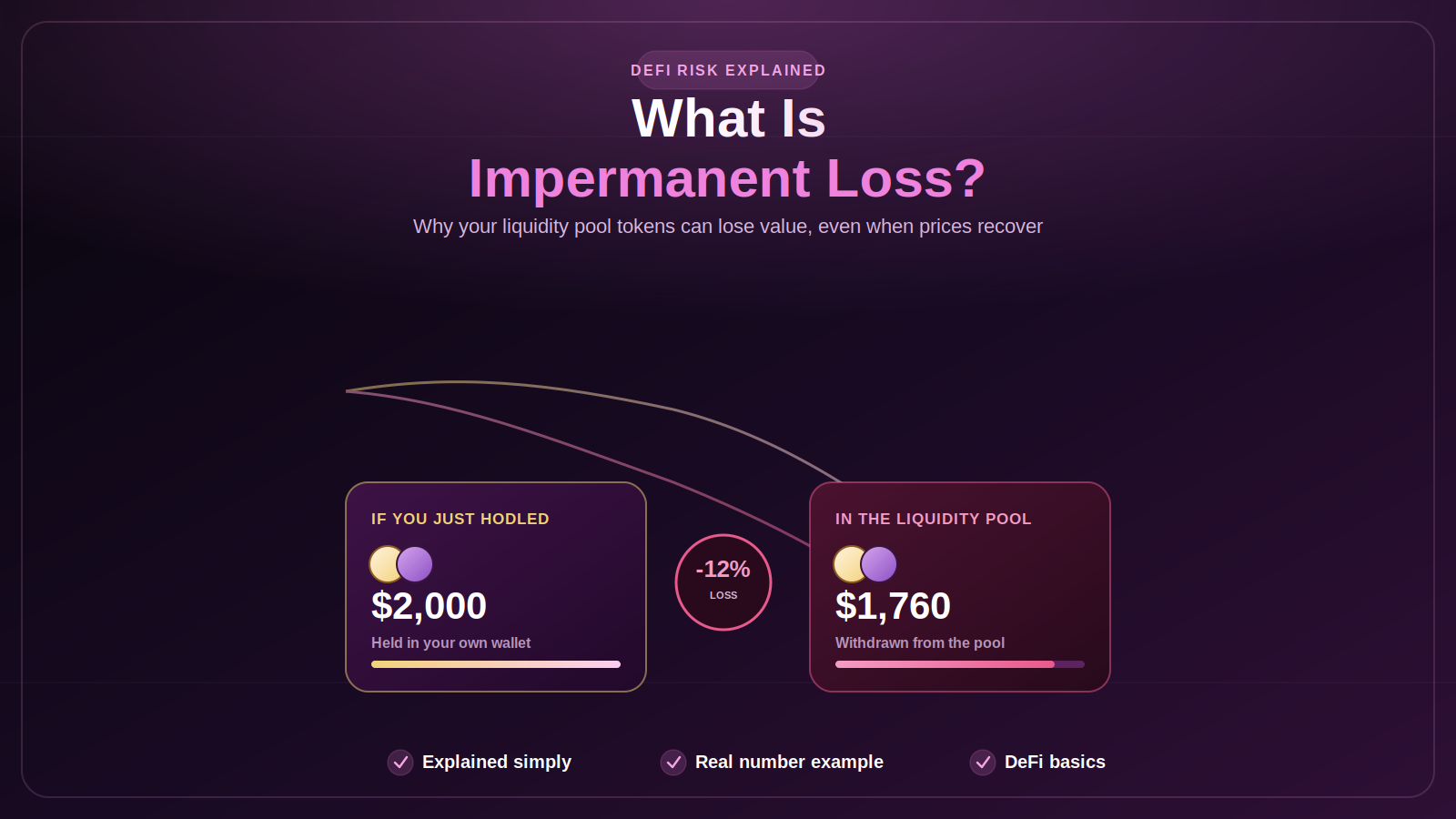
Impermanent loss (IL) is the risk that investors face when depositing their cryptocurrencies into liquidity pools on decentralized exchanges (DEXs). This occurs due to changes in the relative prices of the tokens after the deposits have been made.
This term is used because such a loss may be considered impermanent if the prices of the two tokens revert back to their initial relative prices before withdrawal from the liquidity pool. Otherwise, the loss becomes permanent.
How Does Impermanent Loss Happen?
- Whenever you offer liquidity to a pool, you usually supply two different types of tokens in a certain proportion, for instance, ETH and USDC tokens so that others could trade between them.
- When the market price for one of the tokens starts changing, it causes the liquidity pool to rebalance itself with regards to how many tokens it holds by means of its trading system. You might find yourself holding more of the cheaper token and less of the token whose price has increased.
- As a result, you can lose money on your position as a liquidity provider since you would earn more money if you just kept your tokens in your account.
- This phenomenon is referred to as impermanent loss; however, trading fees may help to mitigate this problem.
Here’s a simple example
Suppose that you deposit 1 ETH and 1,000 USDC. Your Total: 1 ETH + 1,000 USDC
Afterward, the cost of ETH rises substantially relative to USDC.
As a result of the traders buying ETH out of the liquidity pool, the pool rebalances its tokens. In consequence, you will end up with less ETH but more USDC
While your liquidity position may have gained in value, its value can be lower than the value of your initial position, consisting of 1 ETH and 1,000 USDC.
This discrepancy is referred to as impermanent loss.
Why does impermanent loss matter?
- It is critical to note that even if there are trading fees to be earned from the pool, this does not necessarily mean that liquidity provision is profitable compared to holding the asset. This means that a pool with higher trading volumes can make higher fees, but a larger price disparity among the assets in the pool can lead to higher impermanent losses.
- The wider the price disparity among the two assets, the larger the possible impermanent loss.
Which pools have lower impermanent loss?
- Since stablecoin pools (e.g., stablecoin pools with two stablecoins) have assets that are made to maintain similar values, their risks of impermanent loss are relatively low.
- Assets with correlations (e.g., correlated liquid-staking assets or wrapped assets) will have low risks of impermanent loss since their values will be correlated.
- Asset pools with highly volatile and unrelated assets will have high risks of impermanent loss since their values will not correlate.
Can impermanent loss be avoided?
- It may be hard to avoid the impermanent loss when making deposits for a liquidity pool with two assets, but one can minimize the chances by opting for a pool with stablecoins or highly correlated assets.
- One should compare the impermanent loss with the amount of trading fees and other rewards that a pool offers before making any deposit.
- Above all, one should understand the mechanics and risks associated with a pool instead of going for one with a high APY.
In addition to smart contract failure and hacking, the risk of impermanent loss is one of the most crucial ones that one should know about before entering DeFi as a liquidity provider. Impermanent loss happens due to the fluctuation of the price ratio of the assets that form the liquidity pool.
Nonetheless, impermanent loss does not necessarily result in losing your funds. In certain cases, the loss could be balanced by trading fees and other kinds of rewards. The knowledge of price divergence, the mechanism of liquidity pools, fees, and volatility will assist you in making better decisions in DeFi.
FAQs
Is impermanent loss actually a loss?
It represents an opportunity loss compared with simply holding the deposited assets. It becomes a realized loss when you withdraw your liquidity while the price difference remains.
Can I completely avoid impermanent loss?
Not usually in a traditional liquidity pool, but stablecoin and correlated-asset pools can significantly reduce the risk.
Do liquidity-provider fees offset impermanent loss?
They can. If the trading fees and other rewards you earn are greater than the impermanent loss, providing liquidity can still be profitable.
What causes impermanent loss?
The main cause is a change in the relative price of the assets deposited into a liquidity pool. The greater the price divergence, the greater the potential impermanent loss.