



What is Cardano (ADA)? Beginner’s Guide to the Blockchain
Blockchains are no longer just for the transfer of cryptocurrencies. The latest blockchain technologies now offer smart contracts, decentralized applications, digital assets, governance, and even financial services. An example of such a blockchain is Cardano, which was developed based on research, security, scalability, and decentralization.
ADA is the cryptocurrency used in the Cardano blockchain for paying for transactions, staking, and other activities on the network. However, what is Cardano and how does it work? Let us find out.
What is Cardano?
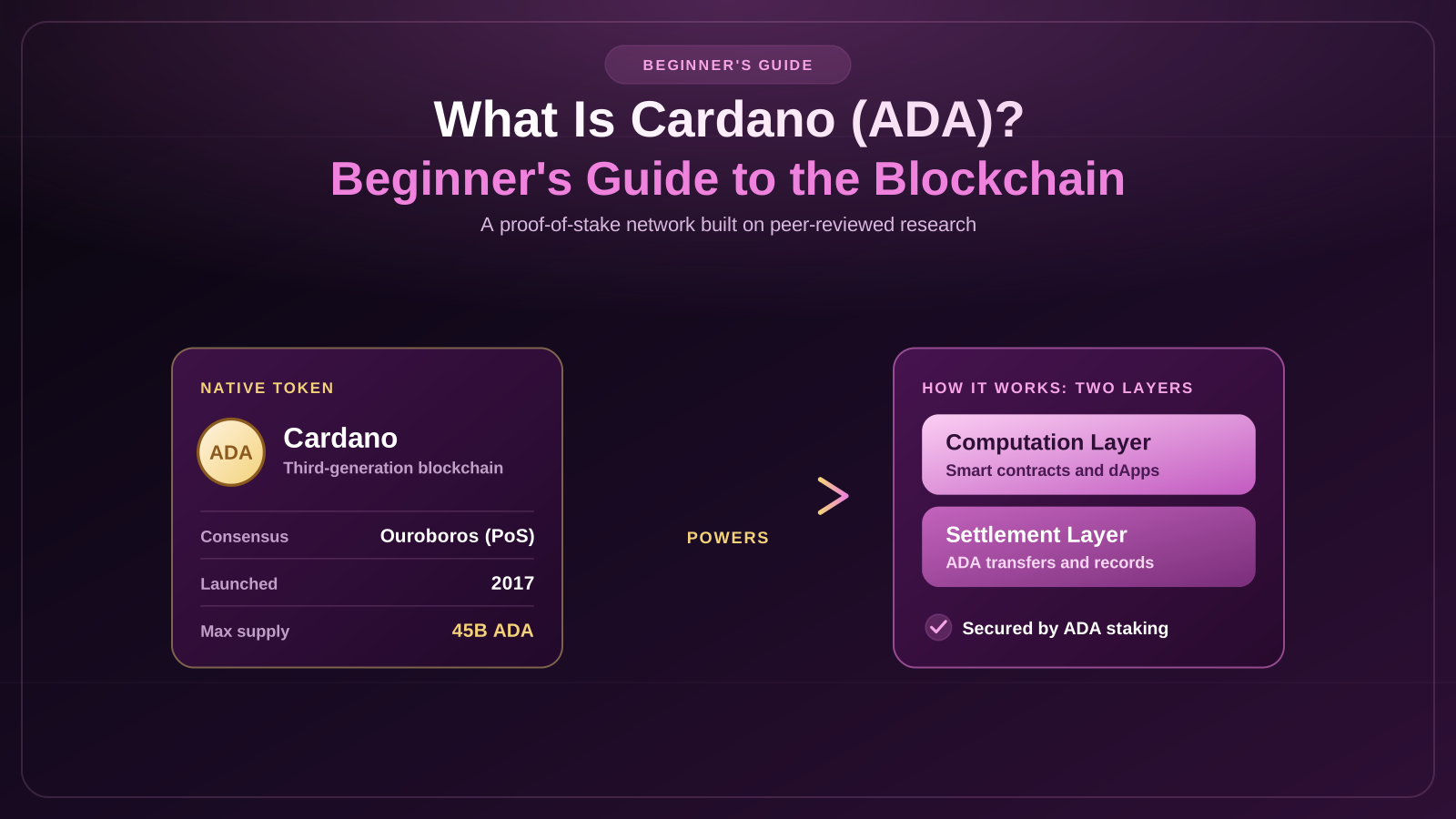
Cardano is a blockchain-based decentralized platform developed to facilitate cryptocurrency transactions, smart contracts, and decentralized applications.
It was created by Charles Hoskinson, who is one of the co-founders of Ethereum, and was introduced in 2017. One of the distinctive features of Cardano is that the platform relies heavily on academic research for its technologies’ development and testing.
The philosophy of Cardano lies in the concept of blockchain infrastructure that must be secure, scalable, energy-efficient, and evolutional.
ADA is the name of Cardano’s cryptocurrency token. ADA is named after Ada Lovelace, a famous 19th-century mathematician known as one of the first programmers in history.
Cardano vs ADA: What’s the Difference?
- Cardano and ADA are different but connected.
- The first one represents the blockchain and technology platform.
- ADA is the digital currency working within the Cardano network.
- The easiest way to explain this is to say that the Cardano network represents the infrastructure and the ADA represents the digital asset functioning within it.
- ADA can be kept, sent, received, staked, and used for other purposes by the users.
How Does Cardano Work?
Whereas Bitcoin relies on the principle of Proof of Work, which utilizes energy-intensive algorithms, Cardano utilizes Proof of Stake technology.
As opposed to Proof of Work, where nodes are engaged in block creation according to their mining power, the network of Cardano is built upon ADA staking.
ADA coin holders can delegate their tokens to stake pools which participate in the block verification and generation.
Staking rewards may be received by the participants of the system depending on their engagement and the state of the network.
It is important to mention that Proof of Stake principle of Cardano is called Ouroboros.
What Can You Do With ADA?
ADA has several functions within the Cardano ecosystem.
Pay transaction fees: ADA is used to pay for transactions and certain operations on the network.
Stake ADA: Holders can delegate ADA to stake pools and potentially earn rewards while contributing to network security.
Participate in governance: Cardano’s evolving governance system gives the community a role in decisions concerning the future development of the network.
Transfer value: Like other cryptocurrencies, ADA can be sent between compatible wallets without relying on a traditional financial intermediary.
Use blockchain applications: ADA can also be used within applications and services built on Cardano.
Smart Contracts and Decentralized Applications
One of Cardano’s important capabilities is support for smart contracts.
Smart contracts are programs stored and executed on a blockchain. They can automatically perform actions when predefined conditions are met, reducing the need for intermediaries.
Cardano’s smart contract functionality enables developers to create applications across areas such as:
- Decentralized finance (DeFi)
- NFT marketplaces
- Blockchain-based games
- Digital identity
- Tokenized assets
- Community and governance applications
Developers can build these applications using Cardano’s blockchain infrastructure while users can interact with them through compatible wallets and platforms.
Why Is Cardano Different?
- Cardano invests significant effort into research and peer review of technologies before their implementation to detect any vulnerabilities and increase the system’s reliability.
- Ouroboros is a solution that enables Cardano to function without cryptocurrency mining. It decreases the dependence of the consensus algorithm on energy-consuming computing processes.
- Cardano can handle higher levels of network activity and remains decentralized. Further development of the network includes attempts to increase the number of transactions per second.
- Cardano is built in such a way that there is a separation between transaction settlement and computing. It provides the flexibility of updating different parts of the network, as the whole blockchain system is not considered one entity.
Advantages and Limitations of Cardano
Cardano has several possible strengths:
- Research-based approach to blockchain building
- Efficient energy-consuming Proof of Stake consensus mechanism
- Smart contract and dApp compatibility
- ADA staking options
- Decentralization and scalability orientation
- Participation in governance by the community
But there are also certain problems. Adoption of blockchain technology is very competitive, and there are other networks like Ethereum and Solana that compete for both developers and users. The research-intensive development process of Cardano may also be the reason why some features appear on the network later.
Also, like any other cryptocurrency, ADA is characterized by considerable volatility.
Is Cardano worth learning about?
Cardano may be valuable if you would like to get to know the principles of creation of modern blockchain networks which go far beyond simple cryptocurrency transactions. The project which employs Proof of Stake, smart contracts, staking, governance, and research-oriented development is a rather important one in the industry of blockchain as a whole.
At the same time, knowing Cardano does not mean that you have to buy ADA. If you would like to invest in cryptocurrency, then you need to understand the technology itself, its risks, market conditions, and your personal situation.
Cardano is a blockchain network which is created to serve as infrastructure for transaction, smart contracts, decentralized applications and digital assets. ADA is the currency of the network.
The research-oriented approach of development and Ouroboros Proof of Stake protocol are what set Cardano apart from many other blockchain projects. Despite all this, the project still competes with others and has risks typical for cryptocurrency.
FAQs
Are Cardano and ADA one and the same thing?
Not necessarily. While Cardano refers to the entire blockchain platform, ADA is its own cryptocurrency.
Is Cardano a Proof of Stake network?
Yes. The network utilizes Proof of Stake protocol referred to as Ouroboros and ADA tokens can be staked at stake pools for network security.
What is ADA used for?
ADA is used as an incentive to pay network fees, for value transfer and staking in addition to governance activities. ADA can be used when working with applications built on Cardano.
Does Cardano support smart contracts?
Yes. Smart contracts are allowed on Cardano and decentralized applications can be developed using the network in such areas as DeFi, NFTs, gaming and more.